
Do You Actually Need Different Gear for Yoga and Pilates?
You’ve probably seen the marketing: “One mat, two practices, infinite possibilities.” As someone who’s spent the last decade teaching both disciplines, and watching students show up with the wrong equipment week after week, I’m here to tell you that your gear matters more than the Instagram ads suggest.
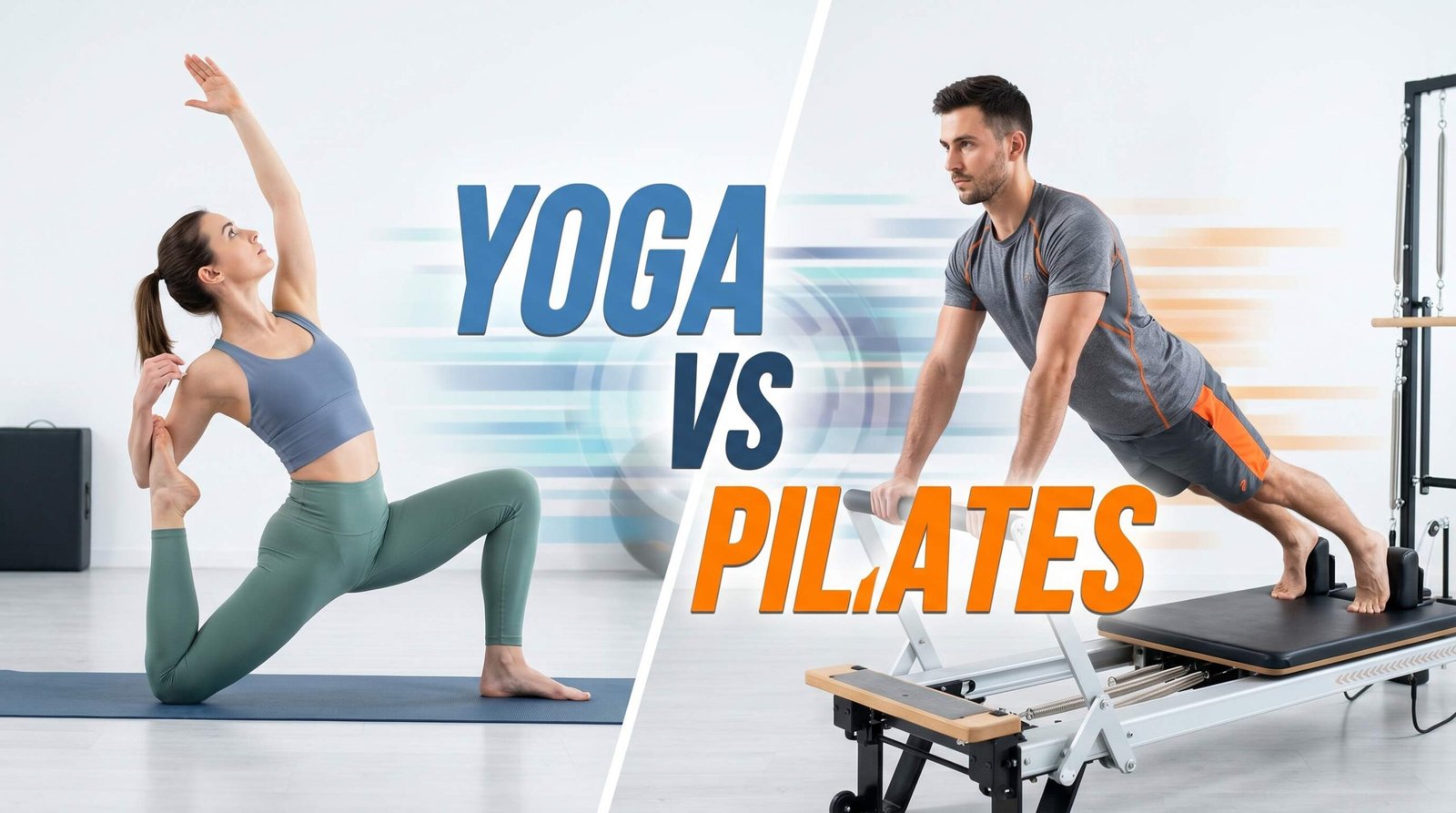
Here’s the truth: yoga and Pilates ask fundamentally different things of your body. Yoga wants you to ground down and find stillness. Pilates wants you to articulate through space with precision. Those different demands require different equipment. Not more equipment necessarily, but the right equipment.
In this guide, I’ll walk you through exactly what you need for each practice, why the gear differs, and how to make smart choices whether you’re a beginner or cross-training between both. By the end, you’ll know precisely what deserves space in your gym bag, and what doesn’t.
The Core Difference: What Each Practice Actually Asks of Your Body
Before we talk gear, we need to talk biomechanics. Because the equipment exists to solve specific physical problems.
Yoga: Grounding, Holding, and Finding Length
Yoga is fundamentally about static holds and flowing transitions between poses. You ground through your feet or hands, hold a shape, and breathe into it. The practice emphasizes:
- Joint mobility through end-range stretching
- Isometric strength (holding positions under tension)
- Balance and proprioception (knowing where your body is in space)
- Breath-linked movement (vinyasa) or deep release (restorative)
What this means for gear: You need stability and grip. Your mat is your foundation. It needs to prevent sliding during downward dog, cushion your knees in low lunges, and provide enough traction that you can hold warrior poses without your feet splaying out.
Pilates: Articulation, Control, and Core Loading
Pilates, developed by Joseph Pilates in the 1920s as “Contrology,” focuses on controlled, precise movements that challenge your core stabilizers. Unlike yoga, you’re rarely holding a static pose. Instead, you’re moving limbs while maintaining a stable center. The practice emphasizes:
- Dynamic stability (keeping your core engaged while moving arms/legs)
- Spinal articulation (rolling through each vertebra)
- Resistance-based strength (using springs, bands, or body weight)
- Neuromuscular control (training your brain to fire specific muscles)
What this means for gear: You need cushioning and support for rolling movements. A Pilates mat is typically thicker (around 0.5 inches) because you’ll spend time rolling on your spine, and a thin yoga mat can feel like torture on your vertebrae .
Expert insight: I’ve watched countless beginners struggle through Pilates roll-ups on a 3mm yoga mat, wincing with every vertebra hitting the floor. The right thickness isn’t a luxury—it’s biomechanical protection.
The Mat Debate: Why Thickness and Density Actually Matter
This is where most people get it wrong. They assume a mat is a mat. It’s not.
Yoga Mats: Grip-First Design
Standard thickness: 3–5mm (1/8 to 3/16 inch) Key features: Sticky surface, dense foam or rubber, textured patterns for traction
Yoga mats prioritize grip over cushioning. When you’re holding a plank or downward dog for 30–60 seconds, you need your hands and feet to stay exactly where you placed them. A slippery mat isn’t just annoying, it’s an injury risk.
Materials matter:
- PVC: Most durable, best grip when sweaty, but not eco-friendly
- Natural rubber: Excellent grip, biodegradable, heavy
- TPE (thermoplastic elastomer): Lightweight, decent grip, mid-range durability
- Cork: Naturally antimicrobial, grip improves when wet, firm underfoot
Real-world scenario: During a hot yoga session, I once watched a student slide face-first into a forward fold because she brought a cheap PVC mat that lost all traction once sweat hit it. She needed a mat with open-cell construction (like Manduka’s PRO series or Liforme) that actually gets grippier when wet.
Pilates Mats: Cushioning-First Design
Standard thickness: 8–15mm (1/3 to 1/2 inch) Key features: Dense, closed-cell foam, smooth surface, extra length sometimes
Pilates mats prioritize cushioning over grip. You’ll spend significant time supine (on your back), performing spinal rolls, and doing exercises like the “rolling like a ball” where your spine contacts the mat repeatedly.
Why the thickness matters:
- Protects your tailbone during hundreds of leg lifts
- Cushions your spine during roll-ups and rolling exercises
- Supports your head and neck during supine work
- Provides a stable surface for side-lying leg series
The trade-off: That extra cushioning means less stability for standing work. If you try tree pose on a thick Pilates mat, you’ll wobble like you’re on a balance beam. This is why I don’t recommend using a Pilates mat for yoga, or vice versa—unless you’re doing only floor-based restorative yoga.
Expert tip: If you practice both and can only buy one mat, get a high-density 6mm yoga mat and add a folded towel under your spine for Pilates rolling exercises. It’s not perfect, but it’s the best compromise.
Beyond the Mat: Props, Equipment, and When You Actually Need Them
Essential Yoga Props (And Why They’re Not Optional)
Yoga blocks (foam, cork, or wood):
- Bring the floor closer to you in forward folds
- Support your hips in pigeon pose
- Create proper alignment in standing poses when flexibility is limited
Yoga straps:
- Extend your reach in seated forward folds
- Help maintain shoulder alignment in binds
- Assist in hamstring stretches without rounding your back
Bolsters and blankets:
- Support joints in restorative poses
- Elevate hips in seated meditation
- Provide warmth and comfort in Savasana
The expert perspective: I used to think props were “cheating”, until I studied with an Iyengar teacher who showed me that props are actually precision tools. A block under your bottom hand in triangle pose isn’t making it easier; it’s allowing you to rotate your chest open properly instead of collapsing into your waist. Without that block, you’re practicing misalignment.
Essential Pilates Equipment (From Mat to Machine)
Pilates ring (magic circle):
- Adds resistance to inner/outer thigh exercises
- Helps engage core during arm presses
- Provides proprioceptive feedback for proper muscle activation
Resistance bands:
- Add load to leg and arm exercises
- Assist with stretching (unlike yoga straps, which primarily support)
- Create variable resistance throughout the movement range
Small exercise balls:
- Support lower back during abdominal work
- Add instability challenge to bridges
- Help maintain proper pelvic positioning
The Reformer (studio equipment):
- Uses spring resistance for progressive loading
- Allows for hundreds of exercise variations
- Provides support for rehabilitation work
Real-world insight: The Reformer isn’t just “fancy Pilates”, it’s fundamentally different from mat work. The springs provide concentric and eccentric resistance (unlike gravity-only bodyweight), which builds strength differently. A 2023 study found that Reformer Pilates was up to 310% more effective at targeting obliques compared to traditional crunches .
Pilates vs Yoga for Weight Loss: What the Research Actually Says
This is one of the most common questions I get, and the answer isn’t as straightforward as “Pilates burns more calories.”
The Calorie Math (And Why It’s Incomplete)
According to the American Council on Exercise (ACE), here’s how a 50-minute session breaks down:
| Exercise Type | Avg. Calories Burned (50 min) | Primary Mechanism |
| Hatha Yoga | 144 calories | Stress reduction, mindful movement |
| Power Yoga | 237 calories | Dynamic flow, elevated heart rate |
| Beginner Pilates | 175 calories | Core engagement, controlled movement |
| Advanced Pilates | 254 calories | Resistance loading, muscle integration |
But here’s what the calorie count doesn’t show:
Pilates builds lean muscle mass, and muscle is metabolically active tissue. The more lean muscle you have, the more calories you burn at rest. So while a single Pilates session might only burn 200 calories, the metabolic boost from increased muscle mass means you’re burning more calories 24/7.
Yoga, particularly dynamic styles, burns calories during the session. But yoga’s real weight-loss superpower is stress reduction. High cortisol levels (from chronic stress) signal your body to store fat, especially around the midsection. Yoga’s emphasis on breathwork and mindfulness has been shown to reduce cortisol and improve mindful eating habits .
The Verdict for Weight Loss
If your goal is purely aesthetic (visible muscle tone, reduced body fat), Pilates has the edge because of its muscle-building and metabolic effects. If your weight gain is stress-related or involves emotional eating, yoga might be more effective because it addresses the hormonal and psychological drivers.
Expert recommendation: Combine both. Do Pilates 2–3x weekly for strength and metabolic boost, plus yoga 1–2x weekly for recovery, flexibility, and stress management. This is the approach I use with clients who have 15+ pounds to lose, and it consistently outperforms either practice alone.
What Is Pilates vs Yoga? A Beginner’s Decision Framework
If you’re completely new to both, here’s how to choose based on your starting point and goals.
Choose Pilates First If You:
- Have a weak core or chronic back pain (Pilates was literally invented for rehabilitation)
- Prefer structured, repetitive movements with clear muscle targets
- Want to improve posture and stand taller without thinking about it
- Need low-impact exercise that’s joint-friendly but still challenging
- Like feeling muscles “fire” and knowing exactly what you’re working
Choose Yoga First If You:
- Feel chronically stressed or have trouble sleeping
- Want to improve flexibility and range of motion
- Enjoy variety (there are dozens of styles from gentle Yin to intense Ashtanga)
- Value the mental/spiritual component of movement
- Need to learn how to breathe properly (most people don’t)
The Hybrid Approach (My Personal Recommendation)
After 12 years of teaching, here’s what I’ve observed: the people who get the best results do both. Not necessarily in the same week, but over time.
Why they complement each other:
- Pilates strengthens the deep core stabilizers that protect your spine in yoga backbends
- Yoga’s hip openers counteract the tightness that develops from Pilates’ focused core work
- Pilates’ precision improves your alignment in yoga poses
- Yoga’s breath awareness enhances your Pilates practice
Sample weekly schedule:
- Monday: Pilates mat (core focus)
- Tuesday: Vinyasa yoga (flow and flexibility)
- Wednesday: Rest or walking
- Thursday: Reformer Pilates (strength)
- Friday: Restorative yoga (recovery)
- Saturday: Active recovery hike
- Sunday: Rest
Common Gear Mistakes (And How to Avoid Them)
Mistake #1: Buying a “Universal” Mat
Those mats marketed for “yoga, Pilates, and everything else” usually fail at both. They’re too thin for Pilates rolling and not grippy enough for sweaty yoga. Invest in discipline-specific mats, or use the towel-compromise I mentioned earlier.
Mistake #2: Ignoring Material Safety
Cheap PVC mats can contain phthalates and heavy metals. If you’re spending 3–5 hours weekly face-down on a mat, choose materials that are OEKO-TEX certified or made from natural rubber/cork.
Mistake #3: Bringing Yoga Blocks to Pilates
Yoga blocks are lightweight foam designed for support. Pilates equipment is designed for resistance. Using a yoga block for Pilates exercises usually means it collapses under load or provides no meaningful resistance.
Mistake #4: Wearing the Wrong Clothing
This is gear too, and it matters. Yoga favors fitted, stretchy clothing that won’t ride up during inversions. Pilates favors form-fitting clothes so instructors can see your alignment, but avoid anything too loose around the waist that bunches during rolling exercises.
FAQ: Your Top Questions Answered
Q1: Can I use a yoga mat for Pilates if I’m just starting out? You can, but it’s not ideal. If you’re doing basic mat Pilates without rolling exercises, a thick yoga mat (5mm+) works temporarily. But once you progress to roll-ups, rolling like a ball, or spine stretches, you’ll want a dedicated Pilates mat for spinal protection.
Q2: Is Pilates or yoga better for belly fat? Pilates targets the deep core muscles more directly and builds lean muscle that boosts metabolism. However, yoga reduces cortisol (the stress hormone that promotes abdominal fat storage). For best results, combine both practices with a nutrition plan focused on whole foods .
Q3: Do I need a Reformer, or is mat Pilates enough? Mat Pilates is sufficient for beginners and provides an excellent full-body workout. Reformers add resistance and variety, which accelerates strength gains. If you have access to a studio with Reformers, try both. If you’re home-based, mat work plus resistance bands gives you 80% of the benefits.
Q4: What’s the minimum gear to start each practice? For yoga: a quality mat, one block, and a strap. Total investment: $60–$100. For Pilates: a thick mat and one resistance band. Total investment: $40–$70. You can add props as you progress, but don’t let gear be a barrier to starting.
Q5: How do I know if I’m doing Pilates or yoga “right” without an instructor? For yoga: Use mirrors to check alignment, or film yourself and compare to reputable instructors on platforms like Yoga Journal or Yoga with Adriene. For Pilates: The “burn” should be in your muscles, not your joints. If your neck hurts during ab work, you’re doing it wrong. When in doubt, start with 2–3 private sessions to learn proper form.
Q6: Can I do both on the same day? Yes, but sequence matters. Do Pilates first (when your core is fresh), then yoga for stretching and recovery. Doing yoga first can fatigue your stabilizers, making Pilates less effective and potentially risking your lower back.Q7: How long until I see results? With consistent practice (3x weekly), most people notice improved posture and core engagement within 2–3 weeks. Visible body composition changes typically appear at 6–8 weeks. Weight loss results depend heavily on nutrition—exercise alone rarely creates significant fat loss.